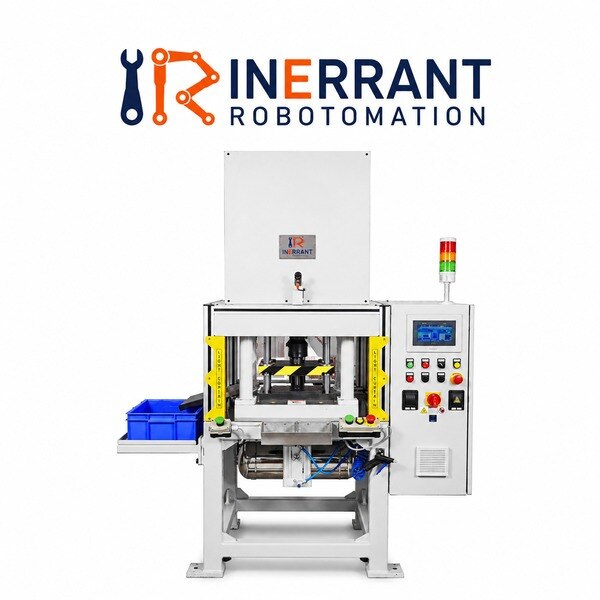
A press that is correctly matched to the operation improves joint quality, cycle consistency and operator safety; a press selected only by nominal tonnage can create slow cycles, premature tooling wear and rejected parts. By the end, you will be able to match common Pune plant applications with the right press type, estimate the required force and prepare a specification that suppliers can quote accurately.
Key takeaways
- Match press type to the operation, material and required force.
- Calculate force from area, material strength, friction and safety margin.
- Compare cycle time, tooling, utilities, safeguards and service—not price alone.
- Request force ratings, drawings, acceptance tests and maintenance details in writing.
Which Pune production operations use industrial presses?
A plant selecting an industrial press machine in Pune should start with the operation, not the industry label. Automotive suppliers use bushing insertion, riveting, staking, swaging, press-fit assembly and straightening; an electrical plant may need terminal crimping, marking and staking.
Appliance and assembly plants use insertion, riveting and fastening, while bearing plants require controlled bearing seating.
Rubber and plastic plants use presses for moulding, trimming, insert assembly and marking. Sheet-metal plants use punching, blanking, forming and embossing. One automotive line may combine insertion, riveting, part ejection and inspection.
Joining and material-changing operations demand different machines:
| Operation | Typical applications | What the press and checks must control |
|---|---|---|
| Joining | Insertion, bearing seating, riveting, crimping, staking, swaging, press-fit assembly | Peak force, stroke position, dwell, part orientation and force-displacement signature |
| Material removal | Punching and blanking | Peak cutting force, tool clearance, stripping, slug ejection and burr height |
| Forming or correction | Forming, embossing, straightening and marking | Stroke, tooling shape, springback, surface condition and final dimensions |
A bench-mounted press suits an operator loading one oriented part at a time and confirming ejection. An inline press receives parts from a conveyor, verifies presence and orientation, performs the operation, then rejects failed pieces. An automated cell adds feeders, robotic loading, die sensors, inspection and traceability through a part or batch record.
Specify how the workpiece enters and leaves the tool before choosing tonnage. Poor loading or orientation creates uneven seating, damaged terminals and false inspection results, even when the press has adequate force.
How do pneumatic, hydraulic and hydropneumatic presses compare?
A 100 mm bore pneumatic press machine at 6 bar produces about 47 kN of theoretical force before friction and efficiency losses. That suits short-stroke, repetitive riveting, staking, crimping, insertion, small-part punching and light forming.
| Option | Force and stroke | Speed, control and repeatability | Energy, noise, maintenance and safety |
|---|---|---|---|
| Pneumatic | Lower force; short stroke | Fast cycles, simple controls, repeatable at stable air pressure; compressed air is elastic, so it cannot hold force rigidly | High compressor energy use, exhaust noise, filters and seals; guard the pinch point and control unexpected cylinder movement |
| Hydraulic | High force; long or adjustable stroke | Slower cycles, controlled speed and dwell; strong force retention for straightening, compression moulding and deep drawing | Pump noise, heat, oil leakage, contamination and seal maintenance; use guarding, pressure relief and hose protection |
| Hydropneumatic | Fast air-driven approach and return, higher-force oil working stroke | Moderate cycle rate with defined working force and repeatable end stroke | More valves, seals and maintenance than pneumatic equipment; protect against stored air and hydraulic pressure |
A hydraulic press machine is preferable for high force, adjustable pressure, controlled speed, dwell, straightening, compression moulding and deep drawing. Compressed air alone is a poor choice for high-force forming, controlled dwell or tightly controlled force-displacement work because its volume compresses and releases like a spring.
Choose hydropneumatics when rapid approach and return must combine with a defined higher-force working stroke, and repeatable force justifies the added maintenance. For a simple joining cycle, pneumatic equipment is usually easier to maintain and faster.
How do you calculate press force and specify the machine size?
Estimate peak process force before choosing tonnage. For insertion and interference fits, use F = interface friction × contact area × interference pressure; include arbor friction and alignment. Forming and straightening depend on material yield strength, geometry, bend radius and springback.
Punching and blanking use F = cut perimeter × sheet thickness × material shear strength, then add stripping, friction and shock allowances. Tool clearance and shear angle change the peak; tensile strength alone mis-sizes the press.
- Calculate the pneumatic press machine force as pressure × piston area. A 100 mm bore at 6 bar gives about 47 kN theoretical force before seal friction, pressure drop and efficiency losses.
- Calculate a hydraulic press machine force as effective piston area × working pressure. A 100 mm cylinder at 200 bar gives about 157 kN theoretical force; reduce it for cylinder efficiency, line losses, tooling geometry and the actual extension or retraction force curve.
- Add allowances for material variation, friction, springback, stripping and shock, then verify final dimensions. Greater interference raises insertion force and changes fit; springback changes the formed angle or straightened length after unloading.
For an industrial press machine in Pune, specify required force at the working position, not nominal tonnage: capacity can fall away from the rated stroke position. State stroke, daylight, shut height, throat depth, bed and bolster dimensions, slide guidance, die weight, cycle rate, tolerance, allowable off-centre loading and available floor space.
Include the force-displacement curve and tooling concept in the quotation.
What utilities, tooling and safeguards affect production performance?
Tooling alignment often determines quality before nominal tonnage does. Specify die parallelism, punch-and-die perpendicularity, guide-post condition, bolster support, slide guidance and allowable off-centre load. Poor alignment creates burr variation, premature punch and die wear, side loading, damaged guides and inconsistent press-fit results.
For a pneumatic press machine, state the minimum dynamic inlet pressure at the machine, pipe size, receiver capacity and permitted pressure drop. Define filtration and drying against ISO 8573-1 air-quality classes, not merely “clean dry air.” A compressor nameplate rating does not prove pressure availability when several machines run together.
Include point-of-operation protection in the machine package:
- Die guarding suited to the tool and loading method
- Interlocked doors, or light curtains or two-hand controls where the hazard assessment requires them
- Anti-repeat logic that prevents an unexpected second stroke
- Accessible emergency stops
- Safe setup or jog mode with restricted motion and controlled access
- Safety-function validation based on ISO 12100 risk assessment and ISO 13849-1 design requirements
Check Pune site conditions before accepting the specification. Measure three-phase supply variation, verify protective earthing and inspect dust around sensors and control cabinets. Control monsoon moisture in air lines and electrical enclosures, and provide hydraulic-oil cooling suited to ambient temperature.
Use contamination control—filtration, sealed reservoirs and scheduled oil checks—to prevent valve sticking, seal damage and unstable force.
How should a Pune plant compare press-machine quotations?
Compare quotations against one production definition, not the biggest tonnage. For an industrial press machine in Pune, require force at the actual working position, stroke, shut height, daylight, bed size, slide guidance, allowable die weight and off-centre load.
- Ask the press machine manufacturer whether cycle time means an unloaded machine cycle or a complete cycle including loading, ejection, die return, sensor confirmation, operator access and safety reset.
- Request force-at-position data, the stroke profile, repeatability results and force-displacement logging.
- Specify pressure gauges, part-presence sensing, recipe control, die-change method and guarding layout.
- Record maintenance intervals, spare-parts availability, operator training and acceptance-test criteria.
- Define acceptance limits for force, displacement, cycle time, noise, alignment, defect rate and safety-device operation.
| Option | What it means | When it applies |
|---|---|---|
| Pneumatic | Fast, short-stroke, lower-force operation | Repetitive joining and light forming |
| Hydraulic | Adjustable force, controlled speed and dwell | Straightening, forming, deep drawing and high-force work |
| Mechanical or servo | High-speed, repeatable strokes | High-volume sheet-metal work |
| Dedicated assembly actuator | Focused low-force motion | Very low-force joining where a press adds cost |
Match the machine to floor space, utility capacity, volume, tolerance and planned automation—not nominal tonnage. A press is the wrong choice when a mechanical or servo press suits high-speed sheet metal, or a dedicated actuator suits low-force joining.
Include Inerrant in the comparison only after supplying drawings, materials, target force, cycle time, tooling concept and inspection method. Before purchase, run representative parts and record force, displacement, cycle time, noise and defect rate.
Related products
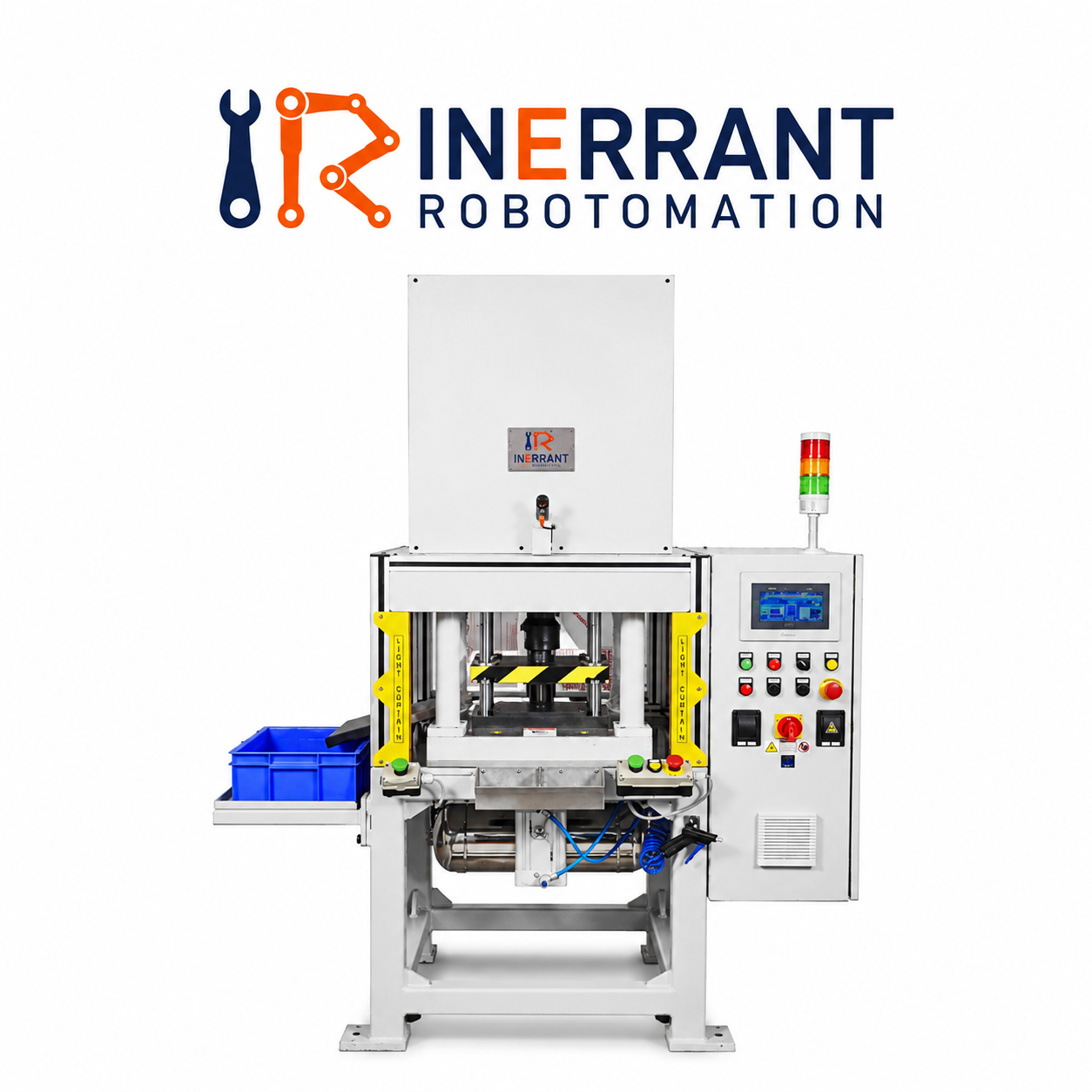 | Press Machine In the modern manufacturing landscape, precision, consistency, and reliability are key factors that drive productivity and quality. View product → |
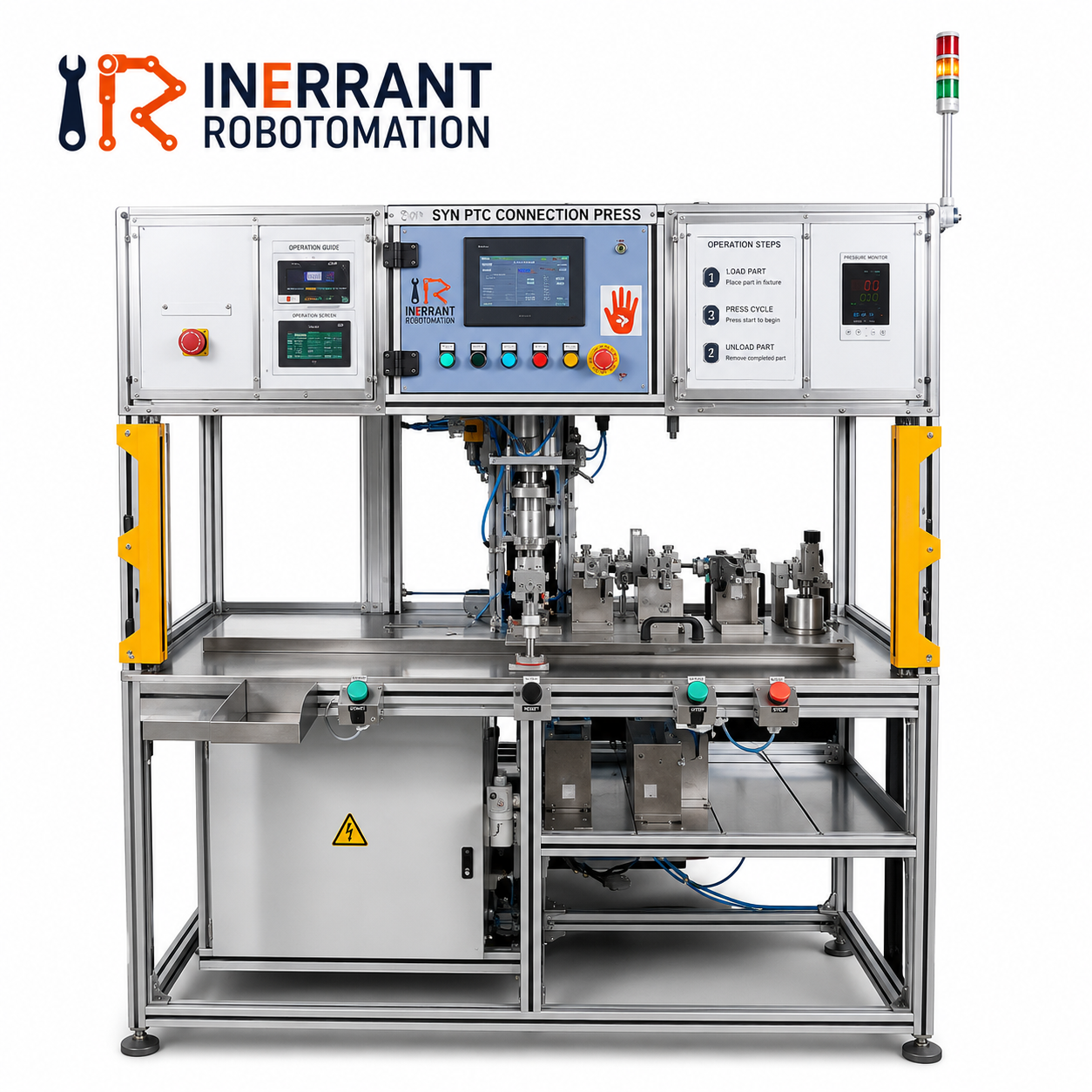 | Press Machine In today’s fast-paced industrial world, automation, speed, and precision are key elements that drive manufacturing excellence. View product → |
Frequently asked questions
Which Pune production operations use industrial presses?
Pune plants use presses for bushing insertion, riveting, staking, swaging, press-fit assembly, straightening, terminal crimping and marking.
How do pneumatic, hydraulic and hydropneumatic presses compare?
Pneumatic presses suit fast, repeatable lighter-duty work; hydraulic presses deliver high force and controlled pressing; hydropneumatic presses combine air speed with hydraulic force.
How do you calculate press force and specify the machine size?
Calculate the required forming or insertion force, add a documented safety margin, then specify stroke, throat depth, bed size, cycle time and force capacity.
What utilities, tooling and safeguards affect production performance?
Check compressed-air quality and pressure, electrical supply, tooling alignment, guarding, two-hand controls, emergency stops, sensors and maintenance access.
How should a Pune plant compare press-machine quotations?
Compare usable force, cycle time, tooling scope, controls, safeguards, installation, acceptance testing, warranty, spares and local service—not the purchase price alone.
Related products
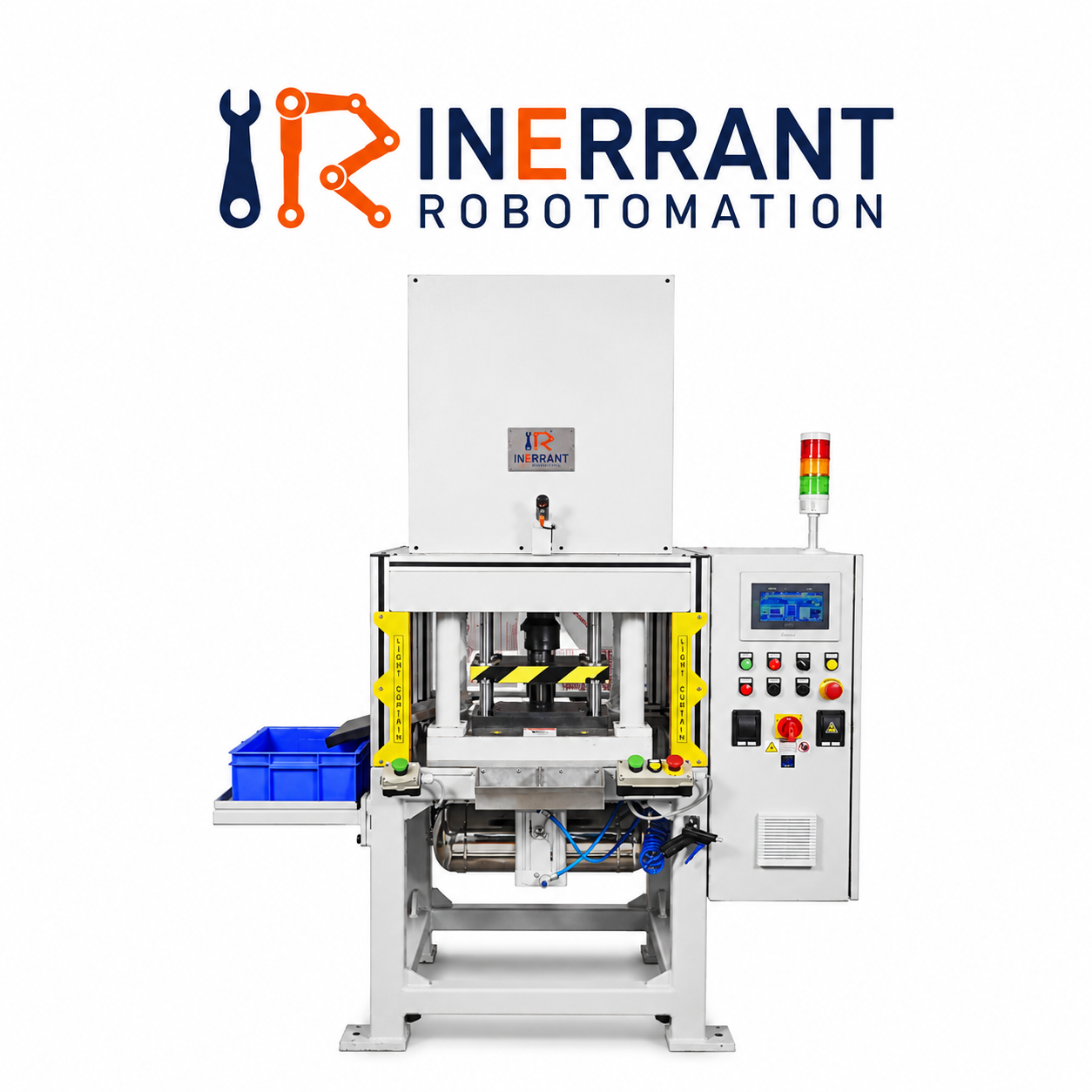 | Press Machine At Inerrant Robotomation Pvt. Ltd., we are one of the leading manufacturers and suppliers of Hydraulic Press Machines designed to deliver precision,... View product → |
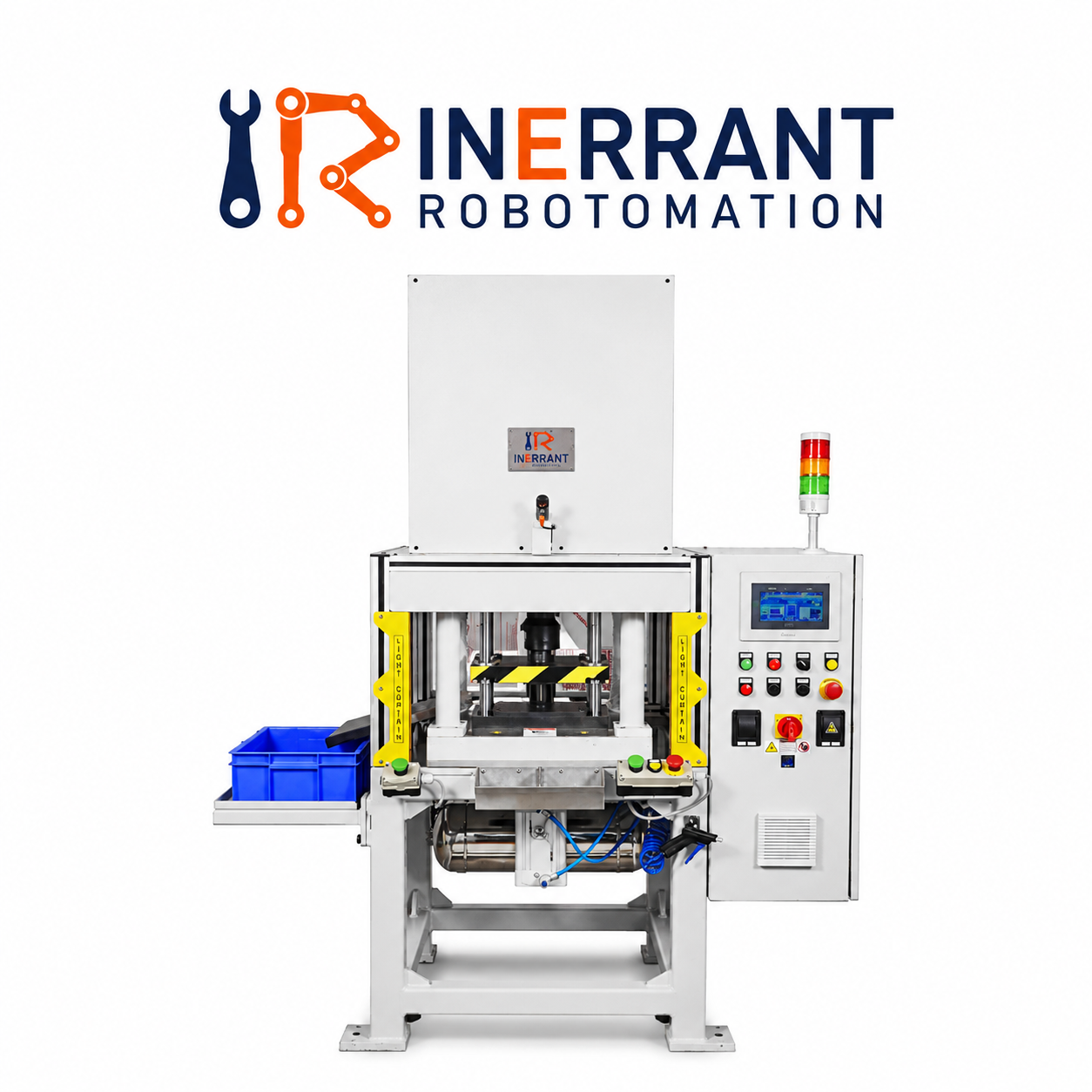 | Press Machine Inerrant Robotomation Pvt. Ltd. provides advanced hydropneumatic press or air-over-oil presses that blend the speed of pneumatic systems with the... View product → |