Pune HVAC plants use pneumatic pressing for repeatable joining, staking, insertion and light forming, but the wrong force, tooling or air supply can create loose joints and damaged sheet metal. You will be able to match each HVAC operation with the right press type, calculate practical force and stroke requirements, and define the controls needed for safe, traceable production.
Key takeaways
- Use pneumatic presses for short-stroke seating, staking, riveting and light forming.
- Choose hydropneumatic or hydraulic presses when force rises or thickness varies.
- Size force, stroke and tooling from material, joint geometry and safety margin.
- Require guarding, two-hand controls, force monitoring and documented acceptance tests.
Which HVAC Components Suit Pneumatic Pressing?
Short-stroke seating, staking, riveting and light forming are the strongest pneumatic press applications for HVAC manufacturers in Pune. Suitable parts include galvanized-sheet and aluminium filter-frame corners, louver pivots, grille clips, brackets, collars, mounting tabs, bushings, pressed inserts and terminal connections.
Use a pneumatic press to clinch overlapping sheet-metal layers, seat a damper bush, insert a louver pivot, stake a linkage rivet, fit a grille clip or form a filter-frame corner. Controlled force and end position avoid the shock, burrs and inconsistent seating associated with impact tools or cutting.
Practical pneumatic press for HVAC components work also includes bracket and end-plate assembly in heat exchangers, duct-component crimping, gasket seating and light fin or tab forming. The joint design must provide pull-out strength and vibration resistance; available tonnage alone does not prove suitability.
- Choose pressing for repeatable assembly or light forming with a short stroke and defined final position.
- Validate a different process for deep drawing, extensive duct flanging, tube expansion or large-area bending.
- Use tube benders or expanders when copper or aluminium work demands control of ovality, wall thinning, work hardening or leakage.
| Operation | Why it suits or fails | Example |
|---|---|---|
| Short-stroke staking | Force-controlled seating | Damper linkage |
| Clinching or clip fitting | Joins overlapping sheet without cutting | Filter frame or grille |
| Deep forming or tube expansion | Needs greater force, rigidity or process control | Heat-exchanger tubing |
A pressed joint does not prove leak tightness. Specify a separate pressure test, stabilization time, pass/fail limit and traceability record for leak-critical fittings.
How Do You Choose Pneumatic, Hydropneumatic, Hydraulic or Mechanical?
Choose a pneumatic press when the joint needs a fast, clean, repeatable short stroke and is defined by a controlled end position or narrow force window.
| Option | Best fit | Main trade-off |
|---|---|---|
| Pneumatic | Clips, staking, riveting, terminal pressing and short-stroke assembly | Fast and compact, but compressed-air generation loses energy and force varies with pressure |
| Hydropneumatic | A rapid approach followed by a slower, high-force phase | More force control than air alone, with added valves, space and maintenance |
| Hydraulic | Continuous high load, long dwell or large-area forming | Strong and steady, but requires oil maintenance, leak control and more floor space |
| Mechanical | High-volume stamping with fixed stroke and production tooling | Fast and efficient at scale, but creates mechanical noise and demands robust guarding |
Use pneumatic equipment for industrial pneumatic press applications such as bracket insertion, grille clips, louver pivots and sheet-metal clinching. Do not use a standard pneumatic cylinder for deep drawing, piercing thick material or high-load bending; its force falls with pressure drop, friction and end-of-stroke effects.
Select hydropneumatic equipment when seating begins quickly but finishes with a slower compression phase. Select hydraulic equipment for sustained force or long dwell. A mechanical press suits dedicated, high-volume stamping where the stroke cannot change.
Compare total energy, not motor size: compressed-air losses can be substantial. Hydraulic systems add oil changes and leak inspection, while mechanical presses add noise and guarding demands. Tube benders, tube expanders and dedicated hydraulic equipment remain better for many copper and aluminium tube operations because they control ovality, wall thinning and leakage risk.
How Should You Size Force, Stroke and Tooling for Pune Conditions?
Estimate force from the actual operation, not the press label. Add the resistance from material thickness and bend geometry to insertion resistance, then apply a defined safety margin. For a pneumatic press machine for uses HVAC manufacturers in Pune, specify working force at pressure, not theoretical tonnage.
1. Calculate the required force for the worst production part, including coating, tolerance and friction. Set the safety margin in the specification and confirm that the force remains available at the ram position where the joint forms.
2. Verify the cylinder with F = P × A. A 100 mm bore has an area of about 0.00785 m²; at 6 bar(g), it produces approximately 4.7 kN before friction, valve losses, pressure drop and end-of-stroke effects. Test at the plant’s actual regulated pressure.
3. Specify stroke, daylight, throat depth, allowable off-centre load, ram guidance, repeatability, cycle rate, tooling envelope and available air flow. A timer alone can leave a damper pivot loose when pressure or sheet thickness changes.
4. Check Pune’s 5–7 bar(g) supply variation, compressor capacity, moisture, oil contamination and dust. Fit a filter-regulator-lubricator air preparation unit where the design requires lubrication.
5. Use guided dies, V-blocks, positive nests, locating pins, anti-rotation features, adjustable stops and quick-change tooling. Add poka-yoke protection against upside-down or incomplete loading; unsupported thin galvanised sheet can dent, tear or distort even within the force rating.
What Controls Keep HVAC Pressing Safe and Repeatable?
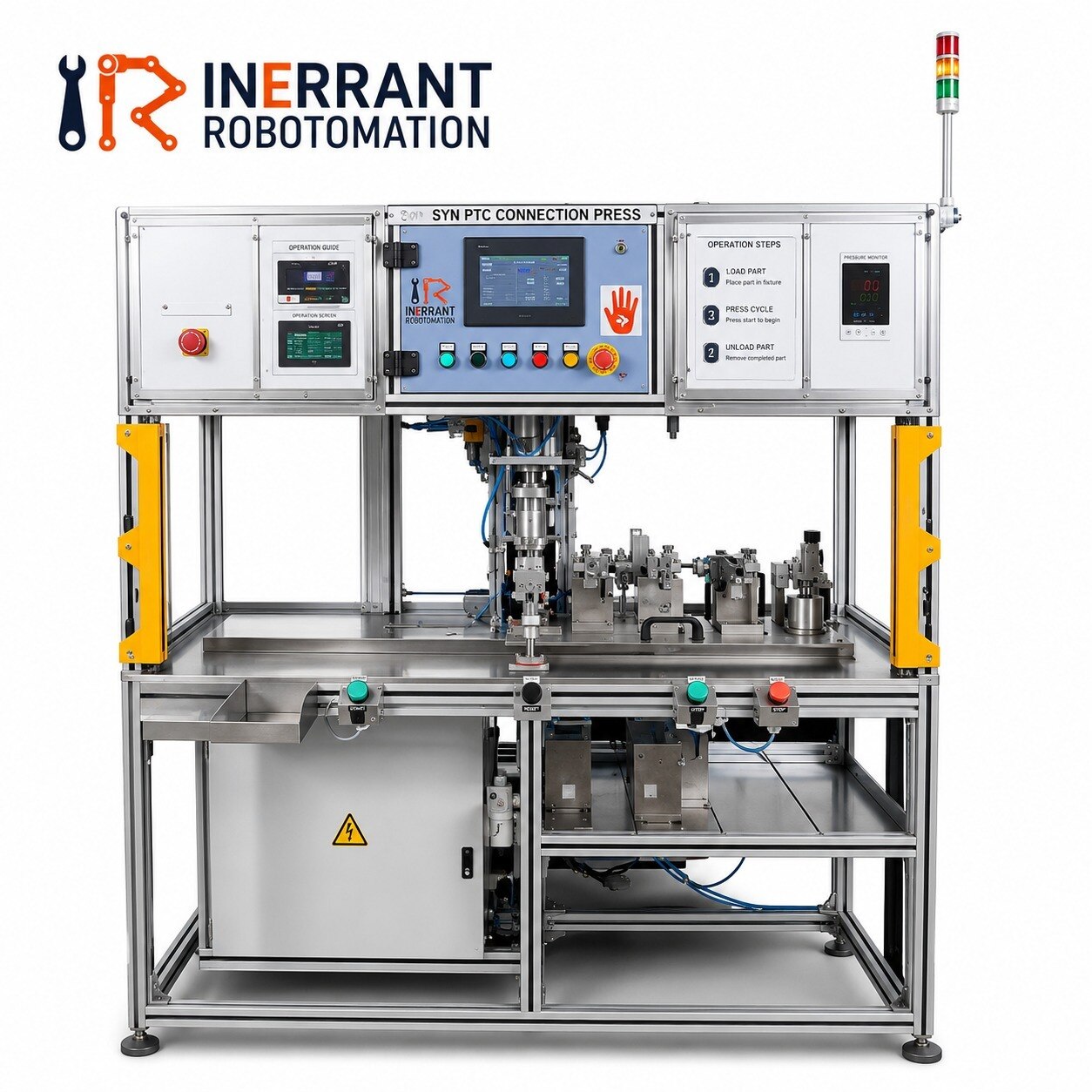
A timer-only cycle can produce a loose joint because it does not prove that the part was loaded, the tool was correct, or the ram reached the required position. Industrial pneumatic press applications need these production signals:
- Part-present confirmation before the stroke
- Recipe selection or correct-tool confirmation
- Ram-home and ram-retracted confirmation
- Regulated air-pressure or force confirmation
- Stroke or end-position monitoring
- Cycle-complete interlock before the operator can remove the part
Reject the component when you find:
- Incomplete seating or loose staking
- Excessive deformation or dimensional drift
- Coating damage, cracks or edge splitting
- A final position outside the drawing tolerance
Record pressure, pressing time, end position, cycle time and pass/fail result against the job number or batch number. Use sample pull-out or destructive tests when joint strength is critical; a satisfactory position signal alone does not prove holding strength.
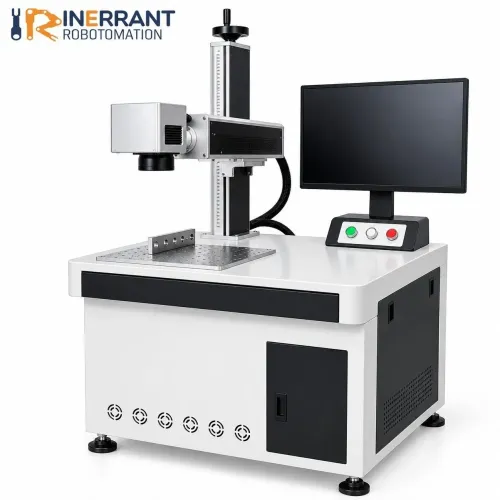
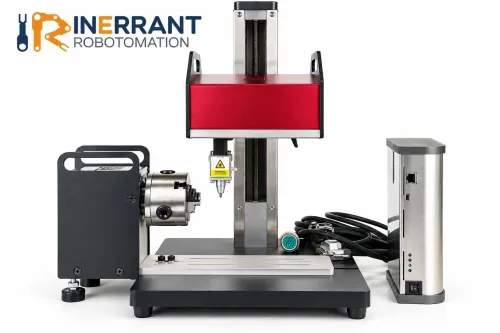
Marking can identify a filter frame, damper part or batch, but it does not replace dimensional inspection or leak testing. For leak-critical assemblies, define the separate test pressure, stabilization time, pass/fail limit and traceability method.
Guard the point of operation and use two-hand controls or an equivalent safeguarding method. Specify dump-valve behaviour after air loss, block unexpected restart when pressure returns, and provide a safe die-change procedure. Apply ISO 4414 for pneumatic-system safety and ISO 12100 for risk assessment and risk reduction.
What Should You Require from a Pneumatic Press Machine Manufacturer in Pune?
Require a pneumatic press machine manufacturer in Pune to prove the process with your actual parts, not an unloaded cylinder demonstration. Specify production sheet gauges, galvanised or aluminium coatings, fasteners, joint geometry and HVAC components; a catalogue tonnage alone cannot show that the joint will hold without dents or coating damage.
Ask the supplier to demonstrate:
- The production nest, guided punch and die, locating features and anti-rotation protection
- Part-present, ram-home, ram-retracted and pressure or force sensors
- Recipe selection, cycle-complete interlock and controls for the intended pressure and cycle rate
- Point-of-operation guarding, safe die changes and the air filter-regulator arrangement
- Recovery after a low-air-pressure fault without an unexpected restart
- A pneumatic press for HVAC components at the specified stroke, daylight, throat depth and air-flow demand
Put these results in the acceptance record:
- Force or pressure trace, ram position, cycle time and repeatability across a defined sample
- Joint pull-out or destructive-test results, with the sample size and pass limit
- Measured operator noise at the working position
- Fault recovery time and the rejected-part response
Compare suppliers against evidence, not location or catalogue force.
| Option | Evidence to compare | Decision use |
|---|---|---|
| Catalogue claim | Rated force and stroke | Initial screening only |
| Production trial | Parts, tooling and recorded results | Confirms process capability |
| Service plan | Response time, spares and controls support | Protects uptime |
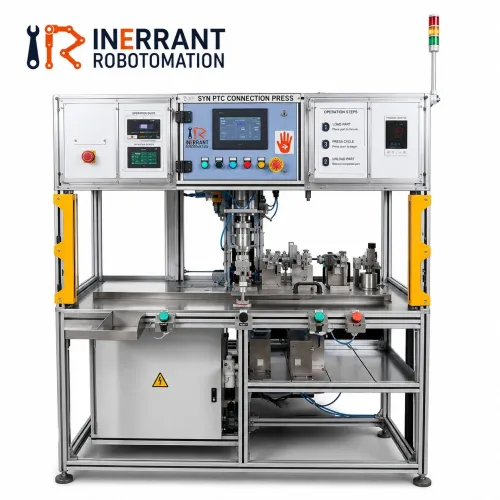
Inerrant, a Pune-based automation manufacturer, is worth including when you need one discussion covering press integration, marking, conveyors or separate leak-testing around the station. Choose it on documented process results and service capability.
Related product
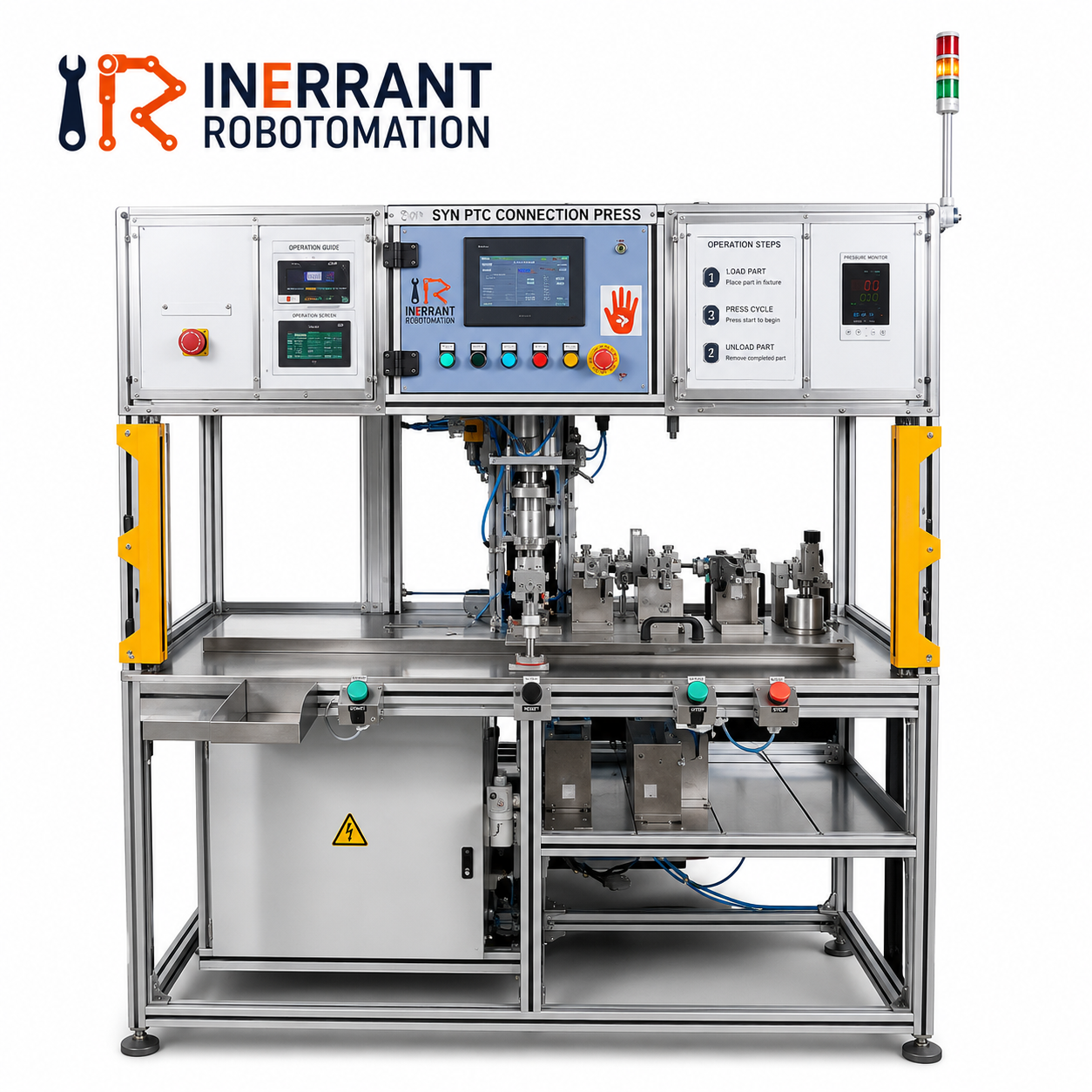 | Press Machine In today’s fast-paced industrial world, automation, speed, and precision are key elements that drive manufacturing excellence. View product → |
Frequently asked questions
Which HVAC components suit pneumatic pressing?
Pneumatic presses suit galvanized-sheet and aluminium filter-frame corners, louver pivots, grille clips, brackets, collars, mounting tabs, bushings, pressed inserts and terminal connections when the operation uses short-stroke seating, staking, riveting or light forming.
How do you choose between pneumatic, hydropneumatic, hydraulic and mechanical presses?
Choose pneumatic presses for fast, repeatable short-stroke work with moderate force. Choose hydropneumatic presses when you need pneumatic speed with a higher force peak. Choose hydraulic presses for high force, longer dwell or variable forming loads. Choose mechanical presses for high-volume work with a fixed stroke and dedicated dies.
How should you size force, stroke and tooling for Pune conditions?
Calculate force from material, thickness, joint geometry and forming load, then add a documented design margin. Set the stroke to clear and seat the part without excess travel, and specify tooling that supports thin sheet without marking it. Check compressed-air pressure, filtration, temperature and humidity at the installation site.
What controls keep HVAC pressing safe and repeatable?
Use fixed guarding or interlocked doors, two-hand controls or a monitored safety device, emergency stops, pressure regulation, stroke limits and part-presence sensing. Add force or pressure monitoring when a missed insert, incomplete stake or cracked sheet could escape inspection.
What should you require from a pneumatic press machine manufacturer in Pune?
Require a force and cycle-time calculation, tooling drawings, utility requirements, risk assessment, guarding details, acceptance-test criteria, spare-parts guidance, operator training and service support. Test sample HVAC parts before approving the machine.