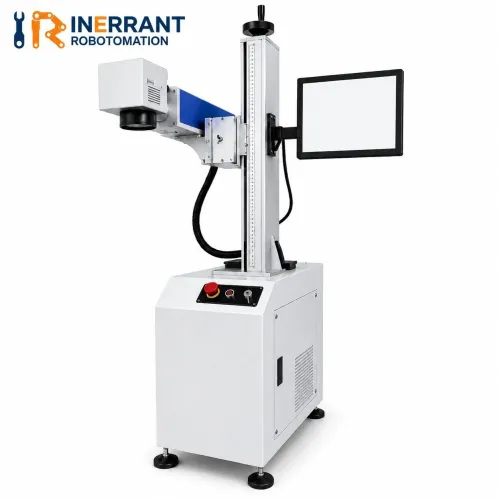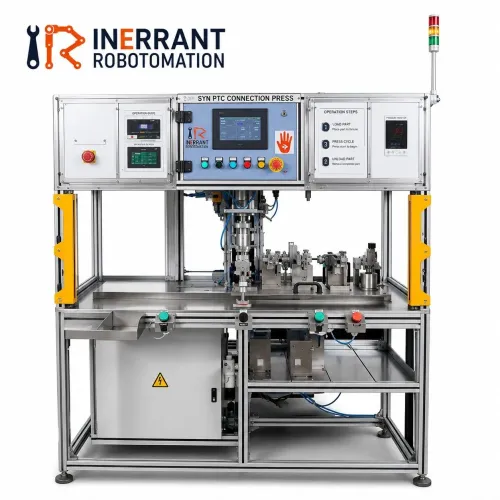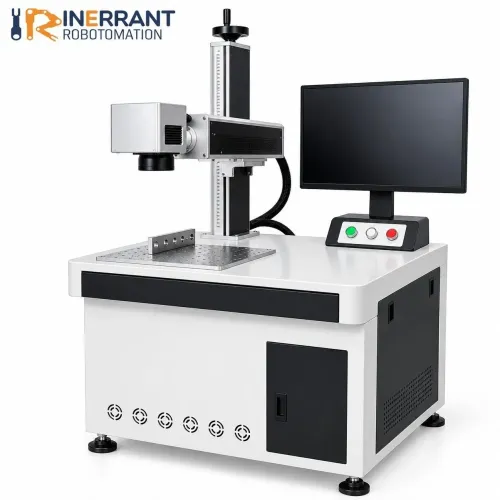
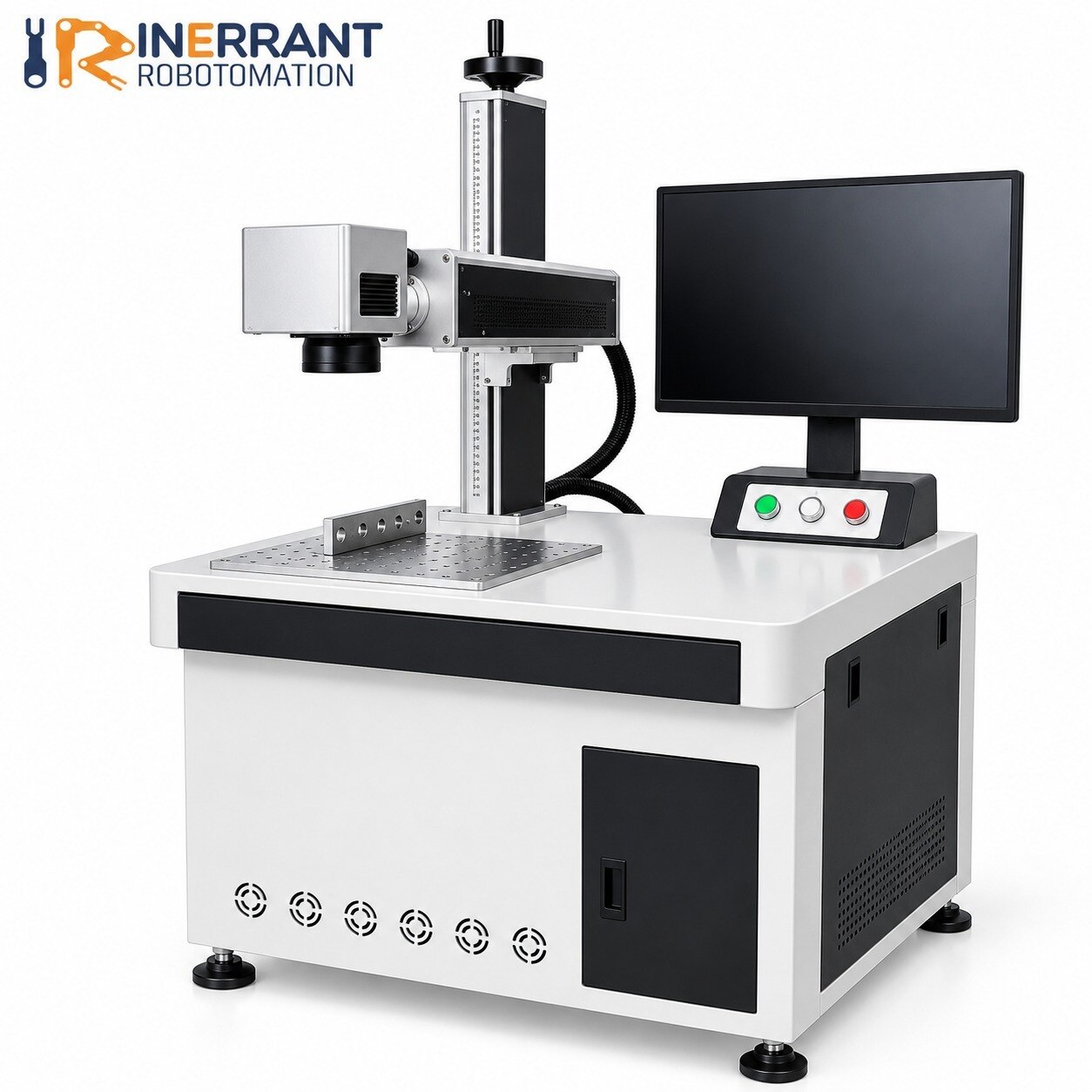
A portable laser marker is not defined by a carry handle alone: the package may range from an exposed hand-positioned head to an enclosed, recipe-controlled workstation. You will be able to audit the quotation, match the laser to your materials, and decide whether portability justifies the compromises in speed, safety, and repeatability.
Key takeaways
- Request the laser source, enclosure, controller, fixture, extraction, and verification list.
- Match wavelength, power, lens, spot size, and marking area to your parts.
- Choose portability when multiple lines need marking without duplicate fixed stations.
- Put safety controls, site utilities, traceability, and acceptance criteria in writing.
What a complete portable automatic laser package must include
A complete package for an automatic laser marking machine for portable use in Pune must show every item needed to position, mark, verify, and move the system—not just the laser’s wattage.
- Physical equipment: laser source and marking head, stated as fibre 1064 nm, CO₂ 10.6 µm, or UV 355 nm; actual marking field; working distance; portable stand or transportable Class 1 enclosure; worktable; dedicated fixture, adjustable clamps, and datum stops; rotary axis if required; cables; fume extractor; and transport case. A flat surface alone leaves part tilt and height variation to change focus and mark position.
- Electrical items: mains voltage and phase, power rating, earthing requirements, controller, touchscreen or laptop, emergency-stop circuit, laser-enable control, and battery or mains power unit. State whether the quotation includes voltage protection and cable lengths.
- Software: user access levels, parameter recipes, job backup or export, serial-number rules, and controls that prevent unauthorised changes to power, speed, frequency, hatch, or focus.
- Automation: part-present sensor, recipe selection, autofocus or vision alignment where specified, automatic loading or operator loading, door interlock where applicable, laser enable, marking cycle, completion confirmation, and fault output. Define whether batch operation is included.
- Acceptance details: mark samples on your stainless steel, aluminium, mild steel, brass, ABS, nylon, painted, and coated parts, plus field accuracy, cycle time, extraction capacity, and operator training.
If the quotation only says “automatic,” ask who positions each part and who confirms each mark.
Match the laser and marking limits to your parts
A 20 W fibre source may mark stainless steel clearly, while a higher-power source reduces cycle time or supports deeper engraving; wattage alone does not guarantee quality. Ask for sample marks at the required line width, contrast, depth, speed and cycle time before choosing an automatic laser marking machine in pune.
| Source | Wavelength | Best-fit materials | Main limitation |
|---|---|---|---|
| Fibre | 1064 nm | Stainless steel, mild steel, aluminium, brass, anodised aluminium, many engineering plastics | Test ABS, nylon and filled plastics because heat can melt, whiten or distort them |
| CO₂ | 10.6 µm | Painted or coated parts, paper, wood, glass and selected polymers | It is not the default choice for bare metals |
| UV | 355 nm | Heat-sensitive plastics, thin coatings and parts needing fine, low-thermal-impact marks | Higher purchase cost and material testing remain important |
Specify the rated power, pulse type, marking speed and spot size. MOPA fibre control can improve colour marking on stainless steel and reduce damage on some plastics, but confirm the result on your actual grade and finish.
Put the marking field, working distance, focal-depth tolerance and maximum part height on the quotation. A larger field reduces repositioning but usually gives a larger spot or lower optical resolution.
Also state the usable part envelope, including diameter, length, weight and any rotary-axis limit; a part that overhangs the fixture can shift during marking and ruin alignment. Use dedicated datums or clamps when height variation would change focus.
When portability beats a fixed marking station
Choose a portable automatic marking machine when you need repeatable, recipe-controlled marks at several workstations or on large assemblies, but cannot justify moving every part to a permanent cell. It suits batch work where an operator positions the unit, loads the part, and starts a controlled cycle.
| Option | Best choice when | Trade-off |
|---|---|---|
| portable automatic marking machine | You need consistent marks, stored recipes, and trigger, sensor, PLC, or foot-switch operation at changing locations | It needs a fixture, power, safety controls, and setup time |
| portable dot-peen marker | You mark bare metal with deep, tactile identification that must survive abrasion | It is louder, slower for fine graphics, and unsuitable for many plastics, glass, or delicate coatings |
| integrated laser cell | You run high volume with automatic loading, guarding, vision, and in-line traceability | It costs more and loses the advantage of moving the marking process between stations |
| manual engraving | You mark occasional repairs, prototypes, or irregular one-off parts | Results depend on operator skill, and batch consistency is poor |
Do not confuse portable automatic with a hand-held laser. The useful configuration has a portable stand or enclosed workstation, repeatable datum stops or clamps, part-present sensing, focus and recipe control, cycle-complete confirmation, and a fault output.
Choose it when repositioning a fixed cell would consume more labour than setup. Confirm the marking field and working distance before purchase: a larger field reduces repositioning but can reduce spot size and optical resolution. Portable automatic marking machine throughput depends on those figures, not quoted wattage alone.
Safety, extraction, and site conditions in Pune workshops
1. Confirm the safety configuration before delivery. A portable laser marking machine in Pune may have a manually positioned head, a stand-mounted head, or a transportable Class 1 enclosure. Ask which applies, then verify guarding, viewing windows, door interlocks, emergency stop, laser-enable control, and warning labels.
An exposed head requires a site-specific laser safety assessment and controlled access.
2. Specify extraction at the marking point, not merely “fume extraction.” The supplier must state airflow, filter type, duct connection, filter-change indication, and exhaust location. Marking painted parts, plastics, coatings, or oily components without suitable extraction can release hazardous fumes and contaminate the optics.
3. Record the electrical requirement: voltage, phase, frequency, full-load current, plug type, protective earth, and UPS or battery limits. Do not rely on an extension lead with unknown earthing. If pneumatic clamping is included, confirm air pressure, flow, filtration, hose connection, and compressor availability before commissioning.
4. Compare the workshop with the machine’s stated ambient temperature, humidity, dust, and condensation limits. Check the quoted marking field and working distance as well; a larger field can reduce repositioning but lower optical resolution.
Measure the footprint, transport weight, doorway route, floor loading, locking casters, and cable travel so movement between stations does not defeat guarding or create trip hazards.
Specify automation, traceability, and the acceptance test
Specify the trigger, recipe control, and part-handling method—not just the word “automatic.” An automatic laser marking machine in Pune is genuinely automatic when a PLC signal, sensor, or foot switch starts a controlled cycle with recipe-based power, speed, focus, and verification.
State whether the operator loads parts into a fixture, whether autofocus or vision alignment locates each part, and whether batch operation continues without manual mark confirmation.
Require the quotation for a portable laser marking machine in Pune to state the marking field, working distance, fixture repeatability, and transportable configuration. A head that the operator manually repositions is not equivalent to a portable stand or a transportable Class 1 workstation.
Ask Inerrant to demonstrate the exact proposed arrangement, including recovery after an interrupted cycle.
For the acceptance test, use production parts—not a polished coupon—and record these results:
- Mark contrast, depth or permanence, location tolerance, and code readability
- Cycle time from trigger to completed mark, including loading and verification
- Serial-number generation or receipt, duplicate blocking, and failed-cycle quarantine
- Logged mark data, verification result, timestamp, operator, and production order
- Repeatability after removing and refitting the fixture
- Recovery from a rejected, paused, or power-interrupted cycle
Sign acceptance only after the machine passes the agreed sample quantity and tolerance. Confirm the marking field and working distance again during the test; quoted laser wattage alone proves neither throughput nor mark quality.
Frequently asked questions
What must a complete portable automatic laser marking package include?
It must cover part positioning, laser marking, control software, fixturing, verification, extraction, safety controls, power, documentation, and transport provisions.
How do you match a laser marking machine to your parts?
Define the material, surface finish, mark type, contrast, character size, marking area, cycle time, and required depth before selecting the laser source and optics.
When is a portable automatic marking machine better than a fixed station?
Portability suits workshops that mark parts at multiple lines, handle varied products, or cannot dedicate floor space to separate fixed stations.
What should a Pune workshop check before installing portable laser equipment?
Check electrical supply, floor space, ventilation, extraction routing, operator access, laser safety controls, ambient conditions, and movement between work areas.