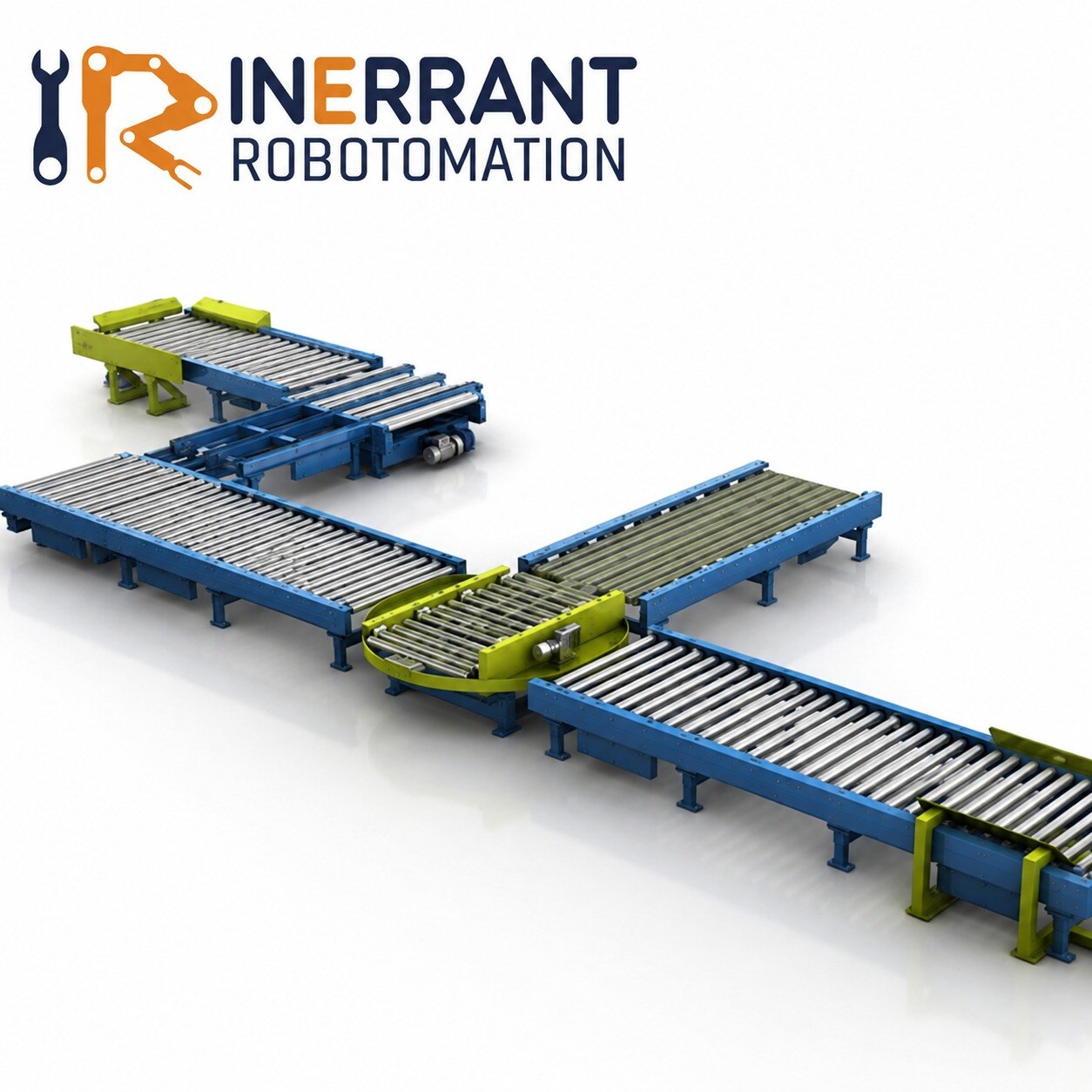
A belt conveyor succeeds when each stage is matched to the product, control logic, safety function and required output—not when a supplier quotes a belt width and motor size alone. You will be able to map the handling sequence, calculate the operating requirement, choose the right belt and conveyor type, and define an acceptance-ready quotation.
Key takeaways
- Calculate throughput from product rate, spacing, load and belt speed.
- Match belt material and conveyor design to product, temperature and contamination.
- Design guarding, emergency stops and sensors before installation begins.
- Prove transfer, inspection and marking performance with documented production trials.
What happens at each stage of a belt conveyor process?
Material moves through a belt conveyor in controlled stages, not as one uninterrupted motor cycle. The process begins with receiving or loading and ends when a downstream machine or operator accepts the discharged product. This sequence forms the foundation of industrial material handling solutions and material handling automation.
| Stage | Material movement | Process type and control |
|---|---|---|
| Receiving/loading | Product enters from a pallet, hopper, chute or operator | Batch loading or metered loading; use a hopper gate, feeder or loading sensor |
| Infeed control | Products are spaced and aligned | Regulated infeed; use photoelectric sensors and a variable-frequency drive |
| Conveying | The belt carries product at the required rate | Continuous transport; monitor running, starved and faulted states |
| Inspection/marking | Product reaches a defined detection point | Indexed or triggered processing; use product sensing and an encoder for position reference |
| Accumulation | Product waits without stopping the upstream line | Zero-pressure or controlled accumulation; divide the conveyor into sensor-monitored zones |
| Transfer | Product crosses to another belt, machine or level | Timed transfer or powered transfer; confirm downstream ready and safe-to-start signals |
| Discharge | Product leaves the belt for packing, storage or the next operation | Metered discharge; use a permissive handshake to prevent overflow |
PLC logic should exchange ready, blocked, running, permissive and faulted signals between stages. A jam timer must reflect product length and permitted dwell time, not merely belt speed. Emergency stops, guards and lockable isolation points stop motion safely without being treated as ordinary process controls.
How do you specify belt width, speed and throughput before requesting a quote?
A belt conveyor in Pune for industrial material handling solutions needs a calculated duty, not a generic “10 metres per minute” claim. Start with the material and production requirement.
- Product length, width, height, weight and underside condition
- Bulk density, particle size, surcharge angle, moisture, temperature and abrasiveness
- Required throughput in pieces per minute or tonnes per hour
- Product spacing, accumulation time and allowable contact between items
- Conveyor length, width, incline angle, loading and discharge heights
- Operating hours, batch pattern, cleaning method and available electrical supply
For discrete products, calculate speed as product pitch multiplied by production rate. For example, a 300 mm product with a 100 mm gap at 60 pieces per minute needs 24 m/min.
For bulk material, use v = Q ÷ (3.6 × ρ × A), where v is speed in m/s, Q is tonnes per hour, ρ is bulk density in kg/m³, and A is the effective loaded cross-section in m². Reduce A for the chosen surcharge angle and loading factor; belt width alone cannot establish capacity.
Check idler spacing, belt tension and drive power using CEMA-style design methods or ISO 5048.
Also send a layout drawing, transfer clearances and site constraints. A supplier can then size the belt, motor, take-up and controls against the actual duty rather than comparing unsupported throughput figures.
Which belt and conveyor type fits the product and operating conditions?
Choose the conveying surface by product contact, temperature, incline and cleaning method, not by belt price alone. PVC suits dry cartons, totes and general packaged goods. PU is the safer choice for oil, grease, frequent washdown or food-contact cleaning when the selected grade meets hygiene requirements.
Rubber handles abrasion, impact and higher temperatures better, but oil can swell unsuitable compounds. Cleated belts stop loose or inclined loads from sliding backward.
| Option | What it suits | When it applies |
|---|---|---|
| PVC belt | Dry, packaged products | Moderate loads and ordinary indoor conveying |
| PU belt | Oil, grease and washdown | Cleanable or food-contact applications |
| Rubber belt | Abrasive, hot or impact-prone material | Bulk solids and demanding transfer points |
| Cleated belt | Loose products or inclines | Elevation changes and controlled spacing |
| Roller conveyor | Rigid flat-bottom cartons, bins or pallets | Accumulation, buffering and low-friction transfer |
| Chain conveyor | Heavy, hot or rough loads | Pallets, metal parts and harsh handling |
| Pallet conveyor | Standardised unit loads | Pallet positioning, stopping and assembly operations |
Select a roller conveyor instead of an industrial conveyor belt when products have a stable flat underside and need accumulation without continuous belt contact. Choose chain or pallet equipment for concentrated loads, pallet stops or severe impact; small packages and irregular bases need a belt.
In Pune, specify drainage, corrosion protection, sealed connectors and sensor-cleaning access for monsoon moisture and process dust. Ask suppliers to document tracking, splice type, guarding, emergency-stop coverage, isolation points, overload behaviour, spare parts and maintenance intervals.
How should controls, safety and site conditions be designed into the conveyor?
A conveyor that reports only “motor running” cannot tell the line whether product is blocked, starved or safe to start. Define handshakes between upstream and downstream equipment so material handling automation can act on ready, running, blocked, starved, faulted, permissive and safe-to-start signals.
Base sensor locations on the product and dwell time, not nominal belt speed:
- Use photoelectric sensors at infeed, transfer and discharge points.
- Give each accumulation zone its own sensor and release logic.
- Start a jam timer when product remains detected beyond the permitted dwell time.
- Add belt-slip, belt-misalignment and motor-overload feedback where the risk assessment requires it.
Set the variable-frequency drive with minimum and maximum speed limits, controlled acceleration and deceleration ramps, current or torque limits, and an overload trip. A slow ramp prevents product tipping; an aggressive restart can damage a loaded belt.
Place emergency stops so a person can reach one from each relevant access area. Follow ISO 13850 principles: reset must be deliberate, and restarting must require a separate start command. Guard nip points, pulleys and transfer gaps; interlock removable guards.
Assign the required performance level through a risk assessment and validate the safety circuit under ISO 13849-1.
Design the panel to IEC 60204-1, including protective bonding, overcurrent protection, control-circuit functions, isolation, documentation and verification. Specify enclosure, connector, cable-gland and motor protection for dust and washdown. In Pune, provide condensation control, drainage, corrosion protection and sensor-cleaning access for monsoon moisture and airborne dust.
Use ISO 5048 for bulk-conveyor power and tensile calculations, not as a guarding standard.
How do you connect inspection or marking and prove the line works?
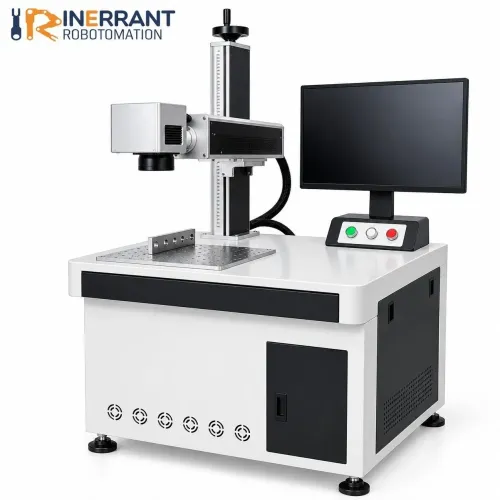
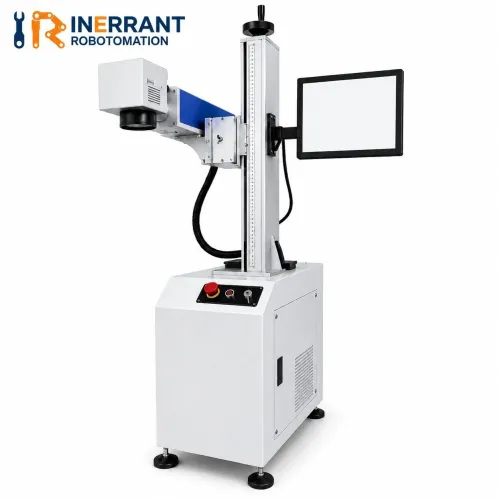
Marking position depends on product reference and motion, not belt speed alone. Connect a product-detect sensor, encoder or equivalent position reference, and trigger-delay compensation to the marking controller. The PLC must load the correct recipe, confirm product identity, and receive verification or reject status.
Specify these interface points before fabrication:
- Product spacing, orientation and allowable gap
- Conveyor speed range and encoder resolution
- Trigger-to-mark distance and mark-position tolerance
- PLC communication protocol, such as Ethernet/IP, PROFINET or hardwired I/O
- Marking-fault response, including whether the conveyor stops, diverts the product or raises an alarm
- Verification result, reject confirmation and traceability data
A supplier quoting an industrial material handling solutions belt conveyor in Pune must prove the complete sequence, not just demonstrate belt movement. Require a factory acceptance test using representative products, the fastest and slowest speeds, minimum spacing, recipe changes, missed triggers, marking faults and reject operation. Repeat those checks during site acceptance after installation.
Put the pass criteria in the purchase specification: throughput, mark location, detection rate, reject accuracy, restart behaviour and data records. Request electrical schematics, I/O lists, PLC and HMI backups, risk assessment, maintenance instructions and IEC 60204-1 verification for the control panel.
Ask Inerrant or any electrical marking machine manufacturer to identify ownership of sensors, software, guarding and final troubleshooting before commissioning.
Related products
 | Conveyors Inerrant Robotomation Pvt. Ltd. builds Belt Conveyor Systems aimed at making material handling more efficient in many industries. View product → |
 | Conveyors Conveyors At Inerrant Robotomation Pvt. Ltd. , we design and manufacture a wide range of industrial conveyor systems that ensure smooth, efficient, and... |
Frequently asked questions
What happens at each stage of a belt conveyor process?
The process covers receiving, loading, conveying, sensing, inspection or marking, transfer and controlled discharge to an operator or downstream machine.
How do you specify belt width, speed and throughput before requesting a quote?
Provide product dimensions, weight, arrival rate, required spacing, accumulation needs and discharge rate, then size belt width and speed from those figures.
Which belt and conveyor type fits the product and operating conditions?
Choose the belt surface, frame, incline, drive and conveyor layout according to product shape, weight, temperature, moisture, oils, dust and cleaning method.
How should controls, safety and site conditions be designed into the conveyor?
Define guarding, emergency-stop access, interlocks, sensors, control-panel location, power supply, floor space, elevations and interfaces with nearby equipment.
How do you connect inspection or marking and prove the line works?
Set sensor positions, trigger timing, reject handling and machine communication, then test speed, spacing, detection, marking quality and fault recovery using documented trials.